Aerial view of the acid mine drainage near Oreton, Ohio by Environmental Humanities Hub

Ben Siegel, American

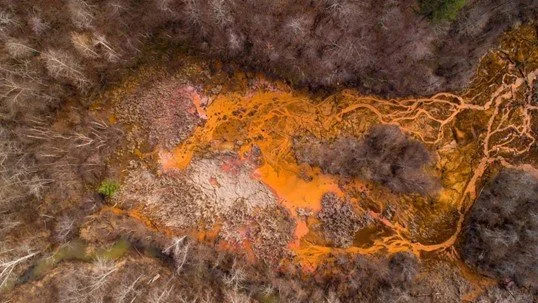
Aerial view of the acid mine drainage near Oreton, Ohio, 2018

There is a beauty to this toxic stream. The vibrant color in a webbed pattern almost looks other worldly. However the depressing reality kicks in when you realize that this is a waterway that has been contaminated by pollution from mines. Water is one of the basic necessities for all life: plants, animals and humans alike. To lose access to clean water leads to issues due to the toxicity, such as cancer. In the readings this week, one of the most striking things that was talked about was the contamination in wells (discussed by Shannon Elizabeth Bell) due to coal slurry injections. This affected entire communities, leading to cancer, teeth loss and many other health problems. How scary is it to not know if the water you are drinking, the water that you need to live, is killing you. To me, this image encapsulates that fear. A toxic stream surrounded by dying trees with no way of containing its runoff and further contamination. Label by Riley Kelley

Ginseng by Environmental Humanities Hub

Unknown artist (Southern West Virginia Photovoice Project participant), American

Ginseng, 2008

A bright photograph depicts an unknown figure in an orange shirt holding a massive, branching Ginseng root. As part of a West Virginian photovoice project, participants were able to take photos that told the story of their community. Many photos from the project depicted environmental hazards, but the long-lasting cultural traditions present in Appalachia came through in photos such as this one. This root would be a striking piece of vegetation on its own, but put into context by both the picture’s caption and the environmental threats within Appalachia, it transforms into a rebellious celebration for nature and the residents of the region. To have this “once in a lifetime” gift, as the label names it, is a welcome contrast to the ‘once in a lifetime’ floods or droughts that have increased frequency due to climate change and industrial destruction. Label by Lia Deasy

Creature Comforts and Bootstrap Stew by Environmental Humanities Hub

Jamie Miller, American

Creature Comforts and Bootstrap Stew, 2022

Miller’s artwork is meant to draw the viewers in with bright colors, folklore, and cute animals. Once she has captured your attention, her work tells a deeper and darker story of mountain destruction, fragile communities, toxic water, and a resilient people. Creature Comforts and Bootstrap Stew depicts a fawn wearing a red bandana around its neck, the communist or union symbol that originally led to the term “redneck.” Patched up, teary-eyed, and stripped of its own heart, I imagine this fawn acts as an activist against the coal and opioid companies plaguing Appalachian communities in honor of the ghosts depicted in the background. Label by Jordan Hadlock

Redlining Map of Richmond, Virginia by Environmental Humanities Hub

Home Owners’ Loan Corporation, American

Redlining Map of Richmond, Virginia, 1937

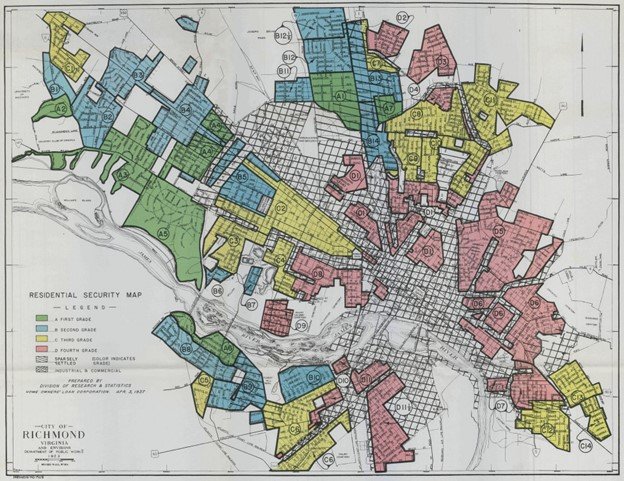
This is a redlining map of Richmond, Virginia. In the 1930’s, the U.S. federal government officially promoted discrimination in housing by allowing the Home Owners’ Loan Corporation to represent predominantly Black communities on such maps in red to classify them as “risky” for investors. This resulted in funding being steered away from these communities. Today this means there are fewer green spaces in redlined areas. Emerging from this is an average heat about 5 degrees hotter than the surrounding communities. In redlined communities without parks, mostly covered in asphalt and concrete, the heat soaks into the ground and radiates heat outwards. As global warming continues, heat waves become worse for members of these communities and pose serious health risks. Label by Annabelle Marcais