Redefining Redlining by Environmental Humanities Hub

Amanda Williams, American

Redefining Redlining, 2022

Williams’ public art exhibition reimagines the injustice of redlining. The artist does this by merging justice and community to create a vibrant scene of red tulips, organized in the shape of the houses that once occupied the area. The tulips were chosen in reference to the steep costs they once held in the historic period of “Tulipmania,” which comments on the wealth gap that was perpetuated by redlining. The work transforms histories of injustice against Black communities into Black joy, highlighting the devastating impacts of redlining while emphasizing the resilience of these communities. Label by Courtney Hand

In Search of Blue Sky by Environmental Humanities Hub

Wendy Wischer, American

In Search of Blue Sky, 2023

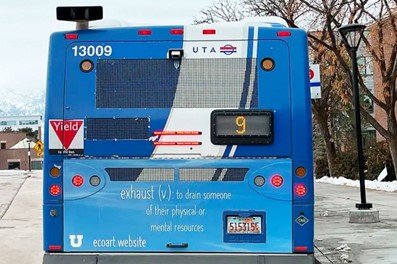
What may look like a normal bus from afar also is actively recording data about air quality. Pasted on the sides of the bus is the image of blue skies with text over it to get people to think deeper about issues impacting their community. With the data from the buses, it has been found that the lower-income areas are those that have worse air quality compared to those of higher income. These art installations of blue skies with wispy clouds, made by Wischer, are meant to spark conversation about poor air quality - specifically in marginalized communities. The hope is that strength will be found in community, and that by sparking these conversations, people will become advocates for one another. I chose this image from this art installation specifically because the word exhaust can have a double meaning. First there is exhaust from pollution that comes out of cars and buses. The other is to exhaust people, just as people of marginalized communities are exhausted at greater rates given the physical conditions they are put in by the poor air quality around them. This double meaning gives a deeper message to this image, making people think of both the exhaust from the cars into the air, as well as how they are affecting the communities they drive through. Label by Riley Kelley

1000-1098 20th St, Newport News, Virginia, 23507 by Environmental Humanities Hub

Unknown artist (Photovoice Camera #31), American

1000-1098 20th St, Newport News, Virginia, 23507, ca. 2020

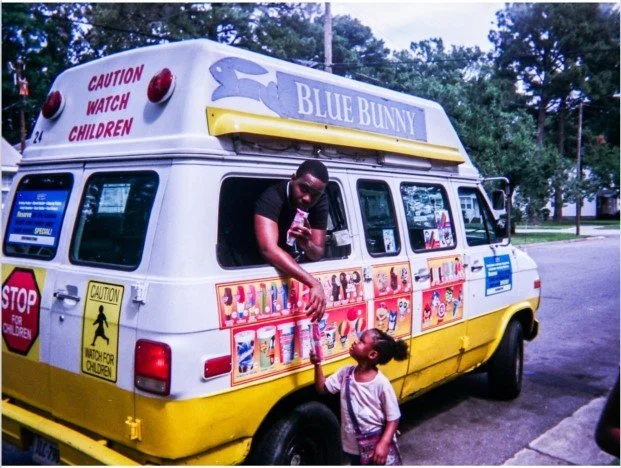
This photo is from a project titled “Photovoice” from Dr. Johnny Finn and the Living Together / Living Apart team. This project gave disposable cameras to community members in the Hampton Roads region and asked them to take pictures of places that are meaningful to them. This photo came from Camera #31 and depicts a local ice cream truck operator and a child buying from him. The photographer begins the caption with “Entrepreneur. Making sure that we support each other. Local business.” This photo embodies the idea of community and belonging in a place. The composition is full of vibrant colors and a warm filter on the entire image, giving it a timeless look. It embodies the joys of childhood. I think the timeless looks makes it relatable to anyone and hearkens back to one’s own time waiting patiently for the ice cream truck. Label by Sam Dutilly

My title: Entrepreneur. This photo was taken as part of the Photovoice project, where locals in the Hampton Roads area were given disposable cameras and told to photograph places meaningful in their life. The person taking the photo described the important aspect of supporting local businesses. They captured an ice cream man handing out ice cream to one of the twenty children the person was with. Each ice cream cost $1.25, but for twenty children, the man sold it at a bargain for $20. This simple moment is an example of how communities support each other. Label by Lucas Theobald

Don't Redline Me by Environmental Humanities Hub

Tasanee Durrett, American

Don’t Redline Me, 2020

Durrett’s painting depicts a young African American woman juxtaposed between maps showing the historical redlining of neighborhoods. Although redlining was made illegal over 50 years ago, its impact is severe, as the subject of this painting conveys through her somber expression. She bears a pendant holding the continent of Africa with red lines streaming from it, symbolizing the journey that was forcefully brought upon millions of people over centuries through slow, systemic violence. The maps are extending from her, representing how the damage brought by those red lines lives on structurally and burdens all those affected. She has her eyes closed, possibly hoping for a reality free from the inequalities that have snowballed throughout generations. Label by Jackson Schiminger