Burned trees on a beach by Environmental Humanities Hub

Angelos Tzortzinis, Greek

2023

Near the village of Gennadi on the Greek island of Rhodes three swimmers go about their business. Behind them lies a forest of burnt trees and damaged wildlife. The striking contrast between background devastation and foreground normality may highlight how people are forced to live in a new normal. In comparison to the tiny figures, the focus of the image lies in the gloom of the threatening forest. And the bird's eye view enables us, the viewers, to witness the absurdity of it all. There is life in front of death, but rather than a scenic beach day, life has been tarnished by the wrath of the wildfires. Label by Grace Cohen

Homecoming by Environmental Humanities Hub

Itzél Rios-Ellis, American

Homecoming

2020

Art historian and cultural critic, T. J. Demos asserts that “Pyro-aesthetics spark effect, discernable too in these flaming images. It begins with the register of fear, including worry, apprehension, dread, foreboding, panic. They extend to pain, invoking agony, anguish, hurt, misery. They move on to sadness, as in depression, dejection, despondency, gloom, melancholy. And they end with disconnection and disassociation, expressed in feelings of alienation and abandonment, immobilization and end-of-world numbness.” This is epitomized in artist Itzél Rios-Ellis’ illustration Homecoming. In the top panel, we encounter a beautifully stylized black and white scene that we have become all too used to on the news: a fire-ravaged home looming over a figure in the center. However, in contrast to many dehumanized images of destruction circulated under headlines or posted on social media, the figure is not just a statistic of the many people who have lost their homes to fires exacerbated by the effects of climate change. Rather she is a personification of the emotional impact experienced. The next two panels represent this—the pain and welling tears in her eyes allow us to empathize with her as opposed to voyeuristically consuming the image of her trauma. The next three images invite us into the metaphorical interpretation of how home can construct the self, while the bottom panel recreates the top image as in an almost “double-death” as coined by ecological ethnographer Deborah Bird Rose, which Demos describes as “The death not only of individual animals, but also the death of livability itself, the latter escaping the realm of the visible.” Label by Courtney Hand

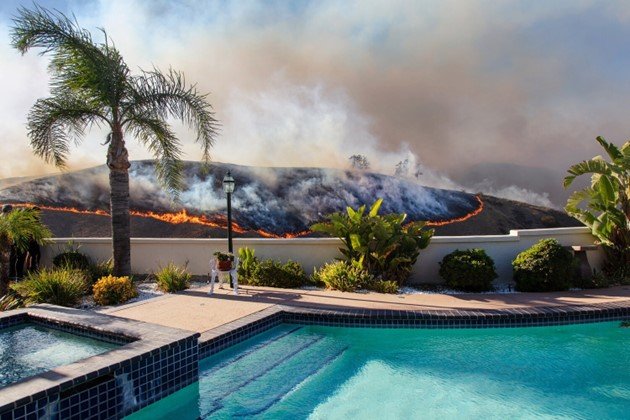
Swimming Pool, Woolsey Fire by Environmental Humanities Hub

Kevin Cooley, American

Swimming Pool, Woolsey Fire

2018

This photograph is a part of Cooley’s series Still Burning, which reimagines how fire impacts humans’ relationship with the environment. This piece depicts a lavish outdoor swimming pool overlooking the Woolsey wildfire in California. Cooley’s artwork questions the sustainability of living in a wildfire vulnerable area, along with the idea of materialism as a physical barrier between humans and the natural world. In this aesthetic yet harrowing photograph, Cooley juxtaposes a wealthy home with an uncontrollable disaster to illustrate the worthlessness of money against fire’s destructive force. This photograph demands our attention to the environment as it becomes more vulnerable to wildfires and urges the viewer to consider the importance of protecting our planet from wildfire disasters. Label by Bayleigh Albert

Come Back Soon by Environmental Humanities Hub

Liz Toohey-Wiese, Canadian

Come Back Soon, billboard

2020

Installed on Highway 97, this billboard was made visible to the public to get them to think more
critically about the frequency of wildfires that are happening in Canada. It is made visible when
heading north from Vernon towards Kamloops. Liz Toohey-Wiese first got inspired to do wildfire
related art during the fires during the summers of 2017 and 2018 when wildfire smoke came all
the way down into the city that she was living in. It was then, in 2020, when Toohey-Wiese saw
her first wildfire in person which inspired the billboard shown above. This art is meant to start a
conversation about human-influenced climate change, and it does just that by creating an
almost sinister warning about how commonplace wildfires have become in the region, getting
the onlooker to reflect on how this could affect the future. Label by Riley Kelley