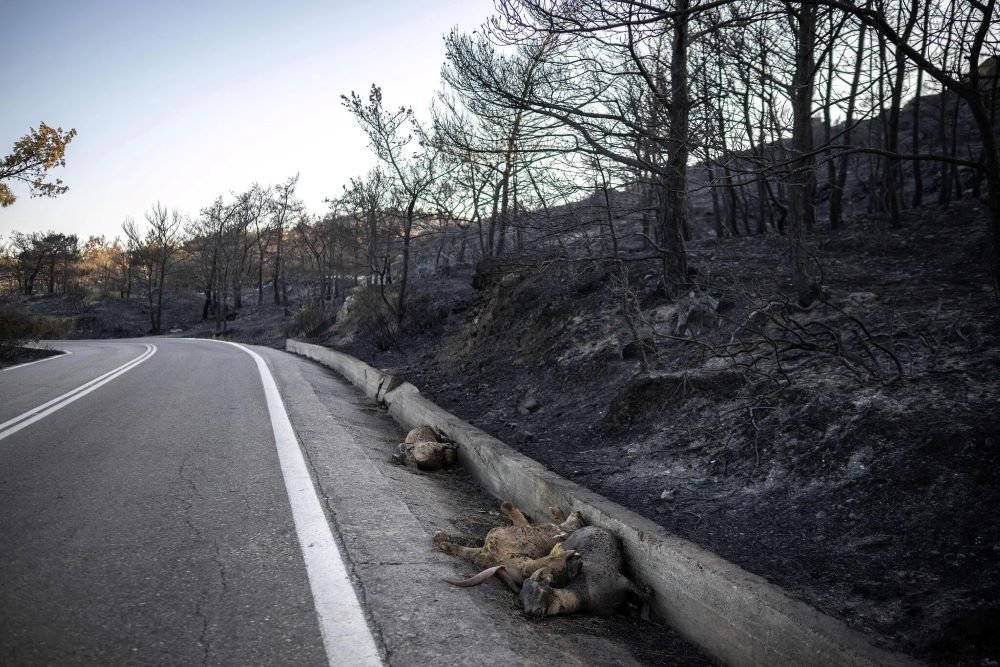
The bodies of goats by Environmental Humanities Hub

Angelos Tzortzinos, Greek

The bodies of goats at the edge of a road on Rhodes on Tuesday, 2023

Amidst devastating fires on the island of Rhodes in Greece, Angelos Tzortzinis aptly captures the systems of ecological violence which threatens our companion species. Just as roadkill are delegated to the outskirts of roadways as we avert our eyes and drive past, the goats are sprawled on the edge of the road, unable to outrun the fire at their backs. While we could avert our eyes and ignore the agonizing nature of the piece, Tzortzinis forces the viewer to truly see each goat in death. Two goats are draped upon each other, appearing to seek comfort from each other. The farthest goat is alone and is curled towards the wall, its face bent away in its own pain. The viewer is forced to consider the stark suffering of nonhuman species in environmental devastation, with the photograph asking us to not avert our eyes. Not this time. Label by Eliza Madison

Residents bracing by Environmental Humanities Hub

Nicolas Economou, Greek

Residents bracing for an approaching wildfire on Rhodes on Monday

Pictured above are residents evacuating from Rhodes, Greece, due to fierce wildfires
across Europe and the rest of the world. It shows the active toll of climate change on humans as
they are forced from their homes, while others are shown driving to the fires, bracing to fight it.
The brightly colored buildings and vibrant ecology of the area are physically dulled due to the
smog caused by the fires. The hazy smoke that fills the image demonstrates the power of slow
violence that climate change creates, with even those not directly in the line of the fire at risk for
health issues. Clarissa Cantacuzene

Locals left fruit for animals by Environmental Humanities Hub

Angelos Tzortzinis, Greek

Locals left fruit for animals near the village of Kiotari on Rhodes on Wednesday, 2023

Tzortzinis is a documentary photographer based in Athens, Greece who often responds to traumatic events, including war and migrant crises. As one of the first responders to Mati’s catastrophic fires in 2018, Tzortzini said it was the most traumatic assignment of his career. The series contains many photos of people evacuating the dead, charred bodies in the street, and images of the aftermath. This image in particular displays the empathy and deliberate care people still carry with them in the aftermath of intense, personal tragedy. Photographed is the food and water several villagers of Mati had laid out for whatever animals may have escaped the grueling flames. Label by Jordan Hadlock

This photo, as the title suggests, is of fruit left for animals by locals in the Greek village of Kiotari after wildfires swept across the island of Rhodes. Clearly focused in the foreground, apples sit alongside some form of nut or seed and a vessel of water, as well as torn (and/or burnt) scraps of fabric. In the background, out of focus scorched earth stretches to the horizon line, peppered with barren and blackened trees. The contrast between the apples’ vibrant color and thevegetative devastation behind them evokes the resiliency of those living in Kiotari; apples occur in this landscape not thanks to natural abundance, as falling from a tree, but by the locals’ solidarity with animals who are also living in the wake of a disaster not of their making. Label by Lia Deasy

Purple by Environmental Humanities Hub

John Akomfrah, British, born 1957

Purple, 2017

Purple comes from an exhibition titled “Our World is Burning” or “Notre Monde Brule” in the Palais de Tokyo in Paris France. The exhibit was shut down for months due to the COVID-19 pandemic which perfectly adds to the message of Akomrah, in which the world is at a breaking point or a point of no return. The dramatized message is displayed from the overwhelming movie theatre view. Purple is the last room of the exhibition. The six screens act to represent the Anthropocene, displaying the various crisis in our world from displaying cruel Animal testing to a melting Mount Everest. The remarkable feature of this work is what should be said for the fact that humans will view these on six large screens from a dark museum in one of the largest cities in the world. As many criticisms mention the issue of placing too much value on to the aesthetics of ecological crisis, Akomfrah tries to combat this by creating an uncomfortable chaos. Playing loud noises of animals and natural disaster viewers are urged to feel unnerved and ready for action. Label by Annabel Bentley