Alicia’s Flatware by Environmental Humanities Hub

Tawnya Lively, American

Alicia’s Flatware, 2017

After her home was destroyed by the October 2017 fires, artist Tawnya Lively launched the “Firestorm Mosaic Project”. Taking broken tiles, kitchenware, and other objects recovered from house fires and refashioning them into mosaics Lively hopes to create new heirlooms out of the ashes of the old. While this began as a personal work of art, Lively has expanded the project, creating images for others, coordinating mosaic artists to complete their own projects, and even “hosting workshops for those who would like to make their own projects”. These pieces tell of the momentous personal and human cost of wildfires, but still create a beautiful work of art that can allow the owners to both remember and move forward from the fires. Label by Caitlin Blomo

Alicia’s Flatware by Tawnya Lively consists of a single dining set that is framed by broken pieces of china of the same style as the half broken cup and burnt plate in the center. The fork and spoon are made of now damaged silver; all of the pieces were salvaged from ashes in California after a wildfire. The pieces together make a full dining set for one person to have a meal, but they are now tattered and unusable. This creates a microcosm of the number of homes and lives that were lost to these wildfires by displaying one set of lonely dishes as if to display a lost meal. Label by Jordan Stofko
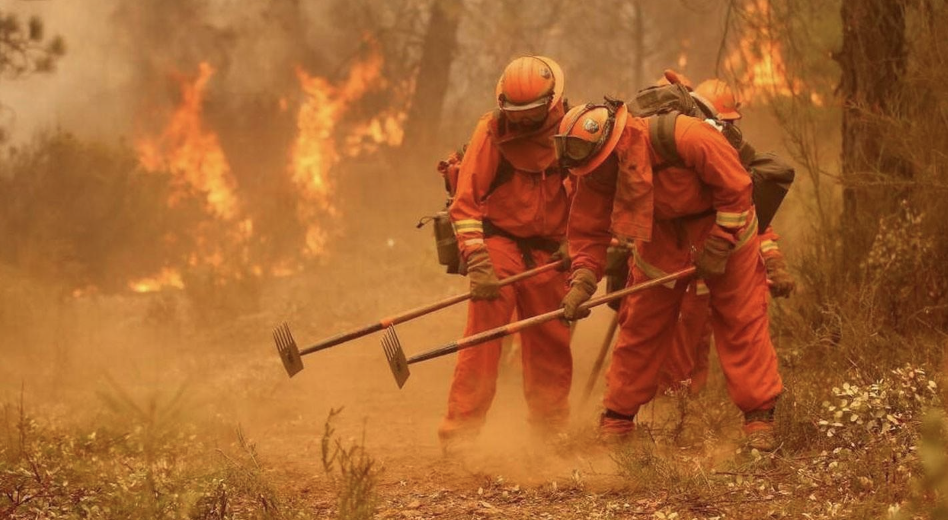
Inmate firefighters build a containment line ahead of the Butte Fire by Environmental Humanities Hub

Rich Pedroncelli, American

Inmate firefighters build a containment line ahead of the Butte Fire, 2015

Two men near Sheep Ranch, California, use rakes to construct a containment line ahead of an approaching wildfire. The orange of their equipment echoes that of threatening flames and dusky atmospherics that surround them. As climate change makes wildfires increasingly frequent, firefighters are called upon more often. In addition to paid professional firefighters, the State of California exploits incarcerated people for their labor as firefighters, paying only $1 per hour and saving the state $100 million annually. In this context, firefighting suits replace jumpsuits, masking the identities of these men and giving them the appearance that they are just other firefighters. These suits also have the effect of masking gross injustice, firefighters who have little, if any, choice in using their labor for these purposes, in horribly dangerous environments, and make pitiful wages doing it. Label by Morgan Brittain

Anthemis Landscape by Environmental Humanities Hub

Tawnya Lively, American

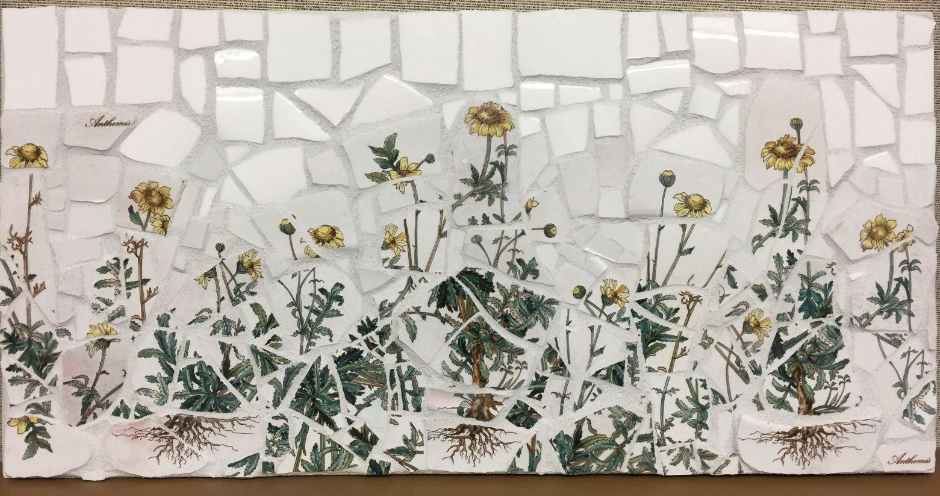
Anthemis Landscape, 2018

This mosaic, a part of Lively’s Firestorm Mosaic Project, is made from the shattered ceramic pieces of a cookware dish that was destroyed in the October 2017 forest fires in California. This mosaic depicts a small landscape scene in which a few yellow flowers bloom into a white sky of fragmented porcelain. On the level of content, Anthemis Landscape highlights the paradoxical struggle of growth from destruction —flowers growing from the ashes of a wildfire are quite literally illustrated by these images of flowers growing out of fragmented ceramic. By taking a material object from these fires and constructing a seemingly optimistic, though contradictory, image of regrowth from cataclysmic destruction, this mosaic also operates as an affective archive of the fires, documenting not just the reality of the event but the inescapable fears, emotions, and hopes which surround and permeate the fires. Label by Maxwell Cloe

Benicia Hammer by Environmental Humanities Hub

Clifford Rainey, British, born 1948

Benicia Hammer, from the “Hand Tools” series, 2018

Glassmaker Clifford Rainey’s studio Napa studio was destroyed in the 2017 Atlas Fire. He lost his entire artistic archive and his studio equipment—his past and future. In an attempt to work through the emotional loss, he began creating artwork using debris from the fire. This triptych consists of a charred metal hammer head, a cast glass impression and a pencil drawing of the hammer.  Rainey’s work addresses the ghostly memory of the lost things we once held, in this case quite literally the burnt wooden handle. All that is left is the impression of it in the hollow glass cavity, rubbed with ashes from the fire. The remaining metal head is now ineffectual as a tool, so Rainey now uses it in a process of healing. For him, the absence of the artist’s hand tool reflects the loss of agency to establish identity, to ensure financial stability, and to create artistic legacy. Label by Kelly Conway

In this work, Rainey repurposes tools recovered from the rubble of California forest fires. The tools are placed in dialogue with both their former purpose and the fires that rendered them unusable. The blueprint like drawings that depict the tools in plain, practical form are interrupted by the smudge of ash. The glass cast of the tool captures the initial strength and form of the tool in space and time while also creating a sense of emptiness. Lastly, the incomplete section of the hammer on the left shows the charred nature of the actual tool. Each of these components of the work speaks to function and utility that has been decimated by the fires. Similarly to these tools, many individuals faced a loss of purpose and function in the wake of the fires. This work speaks to the remembrance of past purpose, while keeping in view the irreversible impact of the fires by demonstrating stark white depictions of the tools alongside the dark smudges and coatings of the burn. Label by Gwyneth McCrae