Untitled by Environmental Humanities Hub

Justin Renteria, American

Untitled, 2018

While this piece is not a direct photograph of mountaintop removal mining in Appalachia, it certainly resembles one. Images of the impact of mountaintop removal share striking similarities to this artistic interpretation of a mining area, devoid of color, splattered with thick oil, seemingly encroaching on the lush surrounding forests. The impact of coal mining in Appalachia is not dissimilar to this physical landscape. As increased environmental degradation has occurred, these energy industries not only strip natural environments of their resources, they strip the land of its color, both figuratively and literally. Not only are mountain tops and forests turned into dreary wastelands, the surrounding communities are stripped of their cultural connections to the lands that they have inhabited for generations, and non-human animal habitats and ecosystems are decimated. The beauty of the nature of the landscapes and the beauty of the human and non-human animals that reside within them are quickly being destroyed by the expansion of these industries. The priority of the industry is exclusively economic growth and development. All other considerations are rendered irrelevant to the progress of the American economy, regardless of the amount of “color” that is stripped from these regions in the process.  Label by Gwyneth McCrae
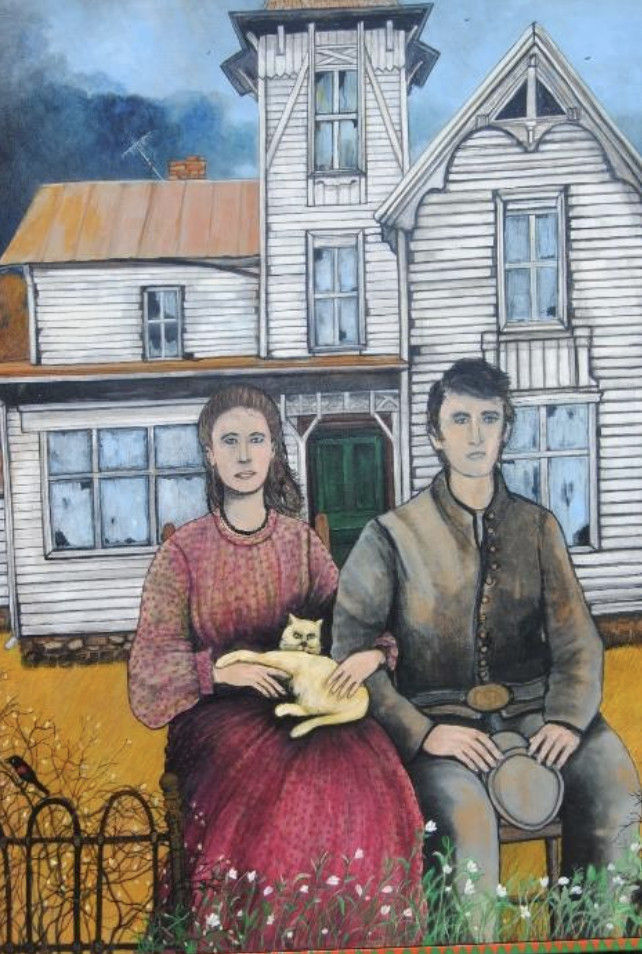
The Owners by Environmental Humanities Hub

Teresa Robinette, American

The Owners, 2017

This piece depicts a man and a woman sitting in front of what is assumed to be their home. The painting radiates a sense of eerie tension. Though the bottom of the painting contains beautiful flowers, the grass appears yellow and dead and a large black cloud looms from behind the stark white house. This piece likely alludes to the predicament of individuals living in areas of Appalachia where coal is prevalent. The couple pictured appears tired and worn down, though they seem relatively young, and a black dust coats their home in the background. The painting itself contains organic compounds from the Appalachian Mountains. The black areas are crafted from broken down charcoal and coal, creating an interesting dichotomy as one sees coal within the painting causing damage and despair, while the coal on the canvas is used as a means of creating. Label by Grace Moser

Toxic Pond by Environmental Humanities Hub


Shannon Elizabeth Bell, American

Toxic Pond, 2008

Shannon Elizabeth Bell provided women in communities in Southern West Virginia with digital cameras and requested that they tell the story of their communities. This project is titled “The Southern West Virginia Photovoice Project” and highlights the impact of mountaintop coal removal through photographs with written narratives. This photograph was taken by the activist Carolyn from a community where the surrounding mountains are covered with large mountaintop removal mining operations. Carolyn’s piece, “Toxic Pond?” displays and  narrates slow violence from hidden coal related pollution within the community. Carolyn’s narrative that is accompanied with the photo reveals the constant unease that permeates throughout the community regarding environmental justice in the form of coal-related environmental problems. Label by Elsa Rall

View from Home by Environmental Humanities Hub

Betsy Jaeger, American, born 1954

View from Home, 2020

View from Home is part of Betsy Jaeger’s current exhibition titled Requiem for a Neighborhood, which examines the effects of a strip mining project that was started and eventually abandoned in her neighborhood of Sugar Grove near Morgantown, West Virginia. The stripping company, after having made its money, declared bankruptcy and left the state of West Virginia to clean up after them, which because of budget concerns may never happen. Many of the works in the exhibition are painted from inside looking out; she contrasts the electricity-powered comfort of the interior with the visible long-term effects of burning fossil fuels in order to alert viewers to the cost of our comforts. Requiem for a Neighborhood also explicitly addresses a shift in the constructed identity of West Virginia as coal country: in Jaeger’s own words, the early 21st century is “a period of change from coal as king to coal as history.” Jaeger uses art specifically because of its accessibility and communicative ability; she wants both to draw attention to these issues for the people of the present and apologize to the people of the future for the damage we have done to the land. Label by Laura Reitze