De money series no. 1 by Environmental Humanities Hub

George Osodi, Nigerian, born 1974

De money series no. 1

De money series no. 1 illustrates twelve young men precariously mining on the edge of a mountain in Nigeria. The men appear almost like cave paintings, two-dimensionally floating upon the rock. Osodi forces the audience to consider how these men’s social situations tip with the same amount of fragility. Such dangerous work speaks volumes of the desperation these young men must face to search for gold in this manner. This work is part of a series that depicts the dangers of illegal mining and oil extraction in Nigeria. Label by Katie Lee

Lips Oil Cans Exhibition 'Lipstick and Agapanthus’ by Environmental Humanities Hub

Sokari Douglas Camp, British-Nigerian, born 1958

Lips Oil Cans Exhibition ‘Lipstick and Agapanthus’, 2018

Sokari Douglas Camp is a British-Nigerian artist known for her work commenting on human rights issues, and the collection this piece is from points towards environmental injustices. In the work, she depicts two “distinctly African” figures, made entirely out of metal oil cans, frolicking together in a field of metal flowers with oil cans on their heads. The piece is playful, yet the grime and grease left on the cans hints to the message she is making about mankind’s dependence on oil and its effect on our relationship with the environment. It is as if the oil industry is overcoming mankind and is inherently connected to how we interact and affect our environment—as the bright white flowers are left covered in the grease while the figures play on top of them. Label by Maeve Marsh

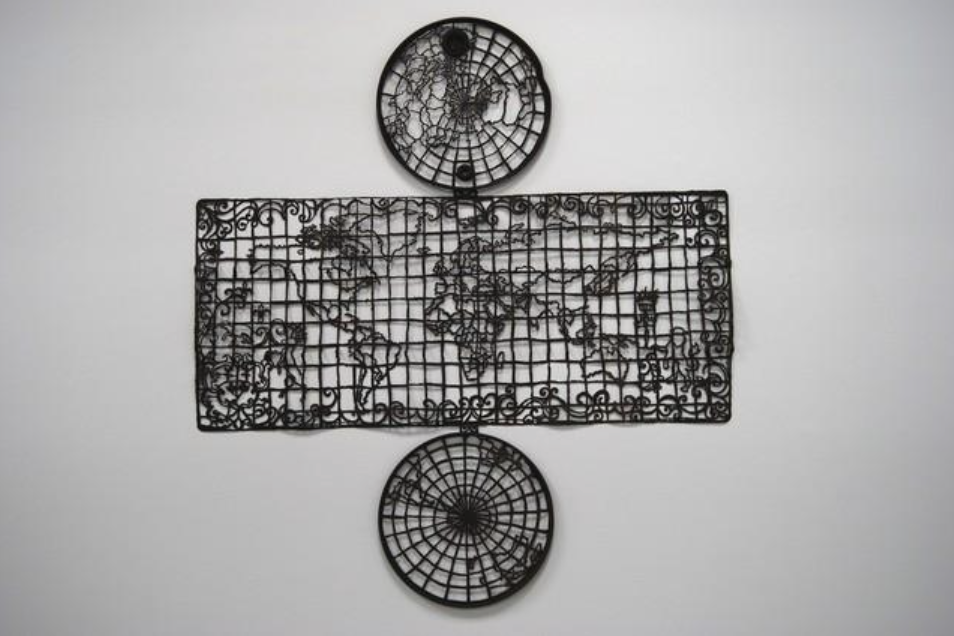
Oil Drum Map of the World #1 by Environmental Humanities Hub

Cal Lane, Canadian

Oil Drum Map of the World #1, 2008

Cal Lane’s “Oil Drum Map of the World #1” serves as both a beautiful example of detailed metalwork and an ironic reference to the oil world. Lane repurposes an old oil drum, carving a map into its surface. This choice of subject matter seemingly suggests that oil extraction is spreading to all parts of the world, or perhaps that the effects of oil are contaminating the world either directly, through leaks and waste disposal, or indirectly, through emissions and the effects of climate change. Lane includes depictions of animal-like creatures within the detailed borders, perhaps alluding to the effects that oil has on nonhuman animals. Label by Grace Moser

Human Cost by Environmental Humanities Hub

Liberate Tate, United Kingdom

Human Cost, 2011

Artists from the art activist organization, Liberate Tate, coordinated a performance, Human Cost, in the middle of the floor of an exhibition in the Duveen Gallery, Tate Britain. An individual from the activist group lay naked on the floor covering their face, while others, clothed in black and veiled by a black cloth, poured an oil-like substance over the nude body from a vibrant green gas canister labeled with BP’s logo. The liquid dripped down the body and puddled around them on the floor. The performance occurred on the first anniversary of the Deepwater Horizon explosion that spilled 4.9 million barrels of oil into the Gulf of Mexico. This staging occurred for 87 minutes, representing the 87 days oil poured into the ocean in addition to protesting BP’s sponsorship of Tate museum. Label by Elsa Rall