Cities Underwater by Environmental Humanities Hub

Norwood Viviano, American, born 1972

Cities Underwater, 2018

In Cities Underwater, Norwood Viviano visualizes the loss of land mass due to sea level rise predicted to occur over the next 500 years in sixteen U.S. cities: Boston, Galveston, Miami Beach, Miami, Mobile, New Orleans, Newark, New York, Norfolk, Philadelphia, Sacramento, San Francisco, Savannah, Seattle, St. Petersburg and Tacoma. Using existing LiDAR data and scientific projections, Viviano crafts an interior sculpture where contours in the glass represent the likely reduction of land in a certain year. These projectile forms are inserted into glass cylinders proportional to the current land area of the featured city. Made in colors ranging from marine blue to seafoam green, we can imagine the vessels filled with water surrounding what remains of the cityscape in 2500 CE. Viviano’s work encourages viewers to think of these coastal cities as organic, fluctuating landscapes that also impact the population and economic vitality of 127,000,000 Americans that call these coastal areas home. Label by Kelly Conway

Boat to Rescue Refugees at Sea by Environmental Humanities Hub

Banksy, United Kingdom

Boat to Rescue Refugees at Sea, 2020

The Louise Michel was a former French Navy boat that was refurbished and funded by British artist Banksy. As popular as Banksy is he finds the art as a part of the solution. While there are many wealthy, popular persons that buy yachts for their personal use, Banksy bought his boat to do good. The beauty in this piece for me isn’t necessarily the railing or the Pepto pink paint, rather in the mission. With all the radical events happening in the world Banksy took it upon himself to have his Louise Michel boat in the middle of the Mediterranean to rescue refugees who are trying to swim for their safety and freedom. This boat holds more power and value than some mega yacht ever could. Banksy for years has used his work to voice against various types of injustice and with this inspiring piece, I believe he perfectly brings meaning to art for injustice. Label by Annabel Bentley

Centro De Permanenza Temporanea (Temporary Detention Center) by Environmental Humanities Hub

Adrian Paci, Albanian, born 1969

Centro De Permanenza Temporanea (Temporary Detention Center), 2007

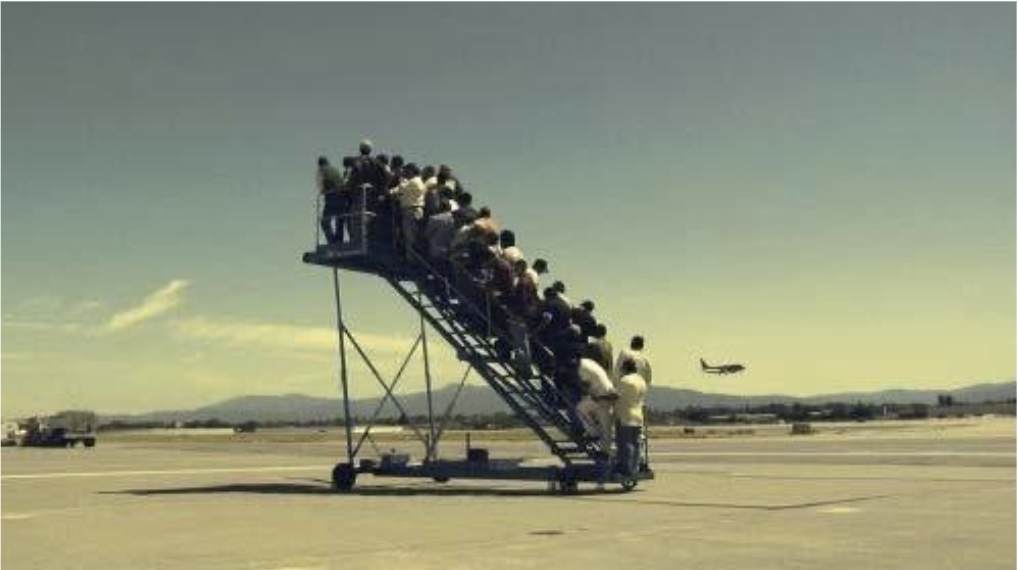
This image is a still from Adrian Paci’s brief film, Centro di Permanenza Temporanea. The still provides a stunning and captivating visual commentary on the insecurity and precarity that accompanies unabating “climate-change induced” mobility (Demos, Decolonizing Nature, 85). The airstairs in this image become increasingly more crowded with people towards the top, all of whom are waiting for a method of a way out that never arrives. This is made even more pronounced by the plane in the background taking flight in the opposite direction. There’s an interesting tension/contrast evident in the title of the image and the conditions it portrays, demonstrating the very way in which these people are perpetually detained within the confines of their precarity. Moreover, this tension is further reflected by the fact that this moment is captured in a photograph—these people are therefore fixed within the confines of this static image, temporarily detained forever. Label by Jay Jolles

In “The Warmth of Other Suns: Stories of Global Displacement,” there is a video clip taken by Adrian Paci called Centro di Permanenza Temporanea, or Temporary Detention Center. In the clip, a crowd of people are squeezed onto a freestanding staircase as they wait for a plane that is slowly driving up to them. In this visual, you see a group of migrants who are on the staircase despite not being able to board the plane due to their urgent desire to leave. In this video, you can feel the group’s anticipation and anxiety that causes them to behave illogically just so that they can feel like they are closer to leaving by completing all the available steps before boarding the plane, even if it does not actually make them any closer to leaving. Label by Jordan Stofko

Underwater Cabinet Meeting, Maldives, October 17, 2009 by Environmental Humanities Hub

Mohamed Nasheed, Maldivian, born 1967

Underwater Cabinet Meeting, Maldives, October 17, 2009, 2009

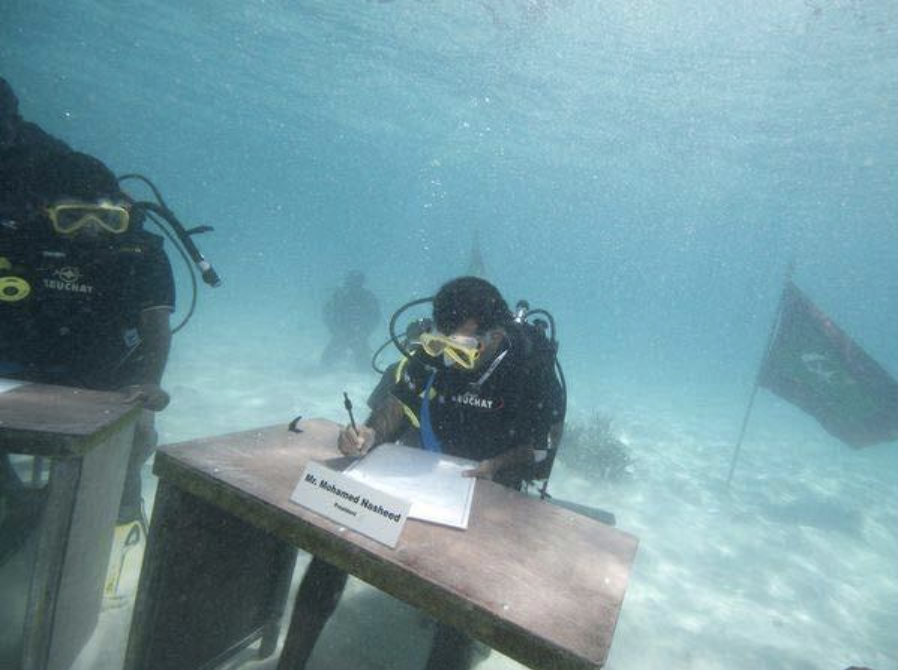
Seated at his desk with the Maldives flag behind him, President Nasheed signs a commitment to make the country carbon-neutral within ten years. This would not be an unusual event or photograph if not for the fact that President Nasheed and his cabinet are fifteen feet underwater, a view of the surface just in the background. With the weight of the ocean pushing down on them, the signers continue their work as normal, not oblivious but focused on the work ahead. Outfitted in scuba-gear, the photo and underwater-signing event directly link the policy actions of the Maldives government to the increasingly urgent threat of climate change. As a small island nation, the Maldives face rising sea levels and coastal erosion, despite the fact that the global solution does not lie solely on their shoulders. This photo forces viewers to confront head on where the world will soon be without immediate action to save it. Label by Caitlin Blomo

Maldivian president Mohamed Nasheed signs a bill promising his nation’s carbon neutrality within a decade. Nasheed sits behind his desk with a pen and the large bill in hand, name placard in front of him and flag of the Maldives behind him in the right third of the composition. The official government photo is unremarkable, with the notable exceptions that the bill-signing ceremony is underwater and Nasheed is in scuba gear, yellow goggles trained on the bill. The image iterates the performative possibilities of government action. The media attention of the spectacle allowed Nasheed to call on the governments of wealthier nations, those who contribute most to climate change, to put forth their own plans to achieve carbon neutrality. Label by Morgan Brittain