La Mer Morte (The Dead Sea) by Environmental Humanities Hub

Kader Attia, French, born 1970

La Mer Morte (The Dead Sea), 2015

This work by Kader Attia depicts the dangers and fate that many migrants face. The name La Mer Morte means the dead sea in English, referring to the risks that migrants face while trying to cross oceans. The various blue colored clothing is to symbolize the ocean that many migrants try to cross. In this piece Attia has used jeans and t-shirts worn by refugees, migrants, and city-dwellers. The clothing coming from migrants is to pay homage to those that have lost their lives trying to migrate to Europe. Attia hopes to remind people how dangerous it can be for those who are trying to create a better life. This installation is located in the The Warmth of Other Suns exhibit in New York that highlights experiences and perceptions of migration and the worldwide refugee crisis. Label by Olivia Falb

This installation addresses the topic of global migration, serving as a memorial to those who have been displaced from their homes due to either climate change or other circumstances. Shoes, jeans, and other articles of clothing are strewn across the floor in ranging hues of blue that mimic the varying tones of the sea. The spacing between the articles of clothing appears to mimic that of a wave, initially spaced dispersedly then becoming tightly packed. This spacing appears to mimic the patterns of migration from rural to urban areas. The sheer number of clothes draws attention to the number of individuals who have been displaced and forced to travel across the ocean. Ultimately, this installation conveys a sense of great loss and emptiness, as the empty clothing alludes to the loss of life on this journey across borders. Label by Grace Moser
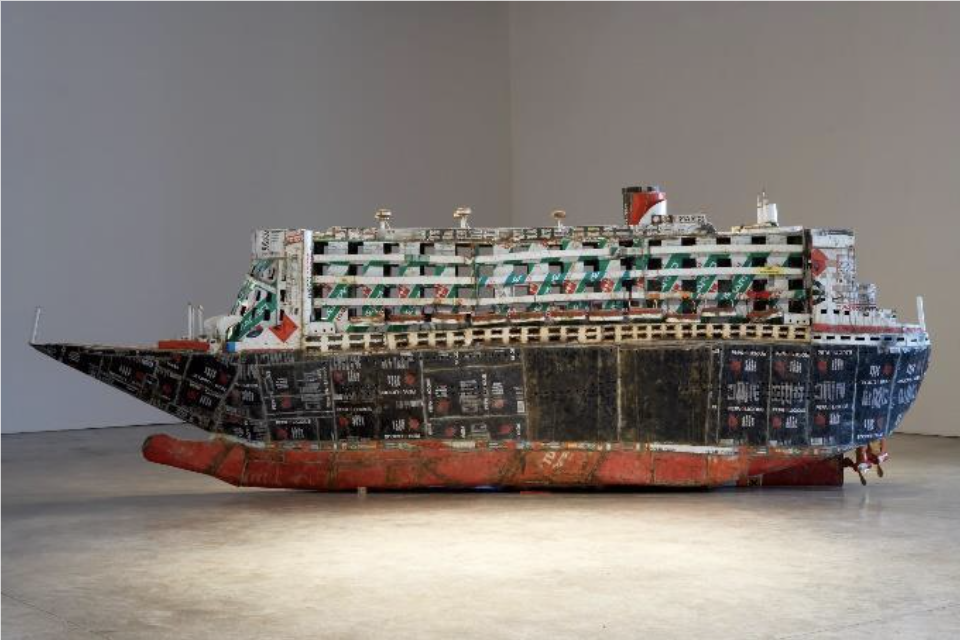
Queen Mary II, La mère by Environmental Humanities Hub

Adel Abdessemed, Algerian, born 1970

Queen Mary II, La mère, 2007

This scrap metal assemblage sculpture, by Algerian Artist Adel Abdessemed, is a scale model of the British ocean liner, Queen Mary II. While not an exact replica of the famous ship, this model is still much larger than a human being. This size, along with the materials of its composition, creates an internal tension within the piece: though it superficially resembles a powerful ship from a massive international imperial force, it contains more similarities with the roughly hewn vessels that refugees use to escape to these imperial cores. The internal conflict of this piece thus draws even more attention to the external conflicts of capitalist imperialism on the whole. These refugees must escape to the imperial core away from problems (such as social unrest exacerbated by climate change) that are a direct result of the capitalist exploitation in their homelands. Label by Maxwell Cloe

Humanitarian Aid Post Hurricane Matthew (#40) / Pestel, Haiti by Environmental Humanities Hub

Meridith Kohut, American, born 1983

Humanitarian Aid Post Hurricane Matthew (#40) / Pestel, Haiti, 2016

Meredith Kohut is an American photojournalist who documents events in Latin America. Kohut’s work's primary focus is on documenting economic and humanitarian disasters in addition to photographing how people in these areas are suffering from severe weather events. Kohut’s photograph, Humanitarian Aid Post Hurricane Matthew #40 / Pestel, Haiti, is a high angle shot looking down at a group of individuals in Haiti waiting to receive food aid following hurricane Matthew in 2016. At first glance the image is chaotic with movement and bold color, but when closely examined reveals the faces of concerned, fatigued, and desperate individuals whose eyes are directed to one location. In the center of the photo is a woman with a furrowed brow and restless hands who appears to be unbothered by the disorder around her, potentially exhibiting the need for help in poverty-stricken communities following a life-threatening storm. Label by Elsa Rall

Unmoored by Environmental Humanities Hub

Mel Chin, American, born 1951

Unmoored, 2018

In Mel Chin’s Unmoored, New York City’s Times Square is seen from rising tides with ships floating above and plankton and other microscopic life swimming about. Through virtual reality, individuals get a sense for what New York City would look like if ice continues to melt from the use of fossil fuels. Mel Chin found that studies have revealed that the use of technology has decreased people’s empathy. In change, Mel Chin wanted this work of art to give empathy through technology instead of taking it away. Overall, the goal of this work is to have more people become aware of the urgency of climate change and its deeply devastating impacts through a method not normally known for doing so. Label by Callie Sties