Bhopal Gas Tragedy by Environmental Humanities Hub

T. R. Chouhan, Indian

Bhopal Gas Tragedy

This is a painting by T. R. Chouhan, a previous MIC plant director at the Union Carbide pesticide plant in Bhopal.  Chouhan was always an outspoken critic of the plant and gave accounts of the mismanagement and disregard for safety that ultimately led to 40 tons of toxic Methyl Isocyanate gas being released into nearby communities, killing or injuring hundreds of thousands of people.  Here he depicts this hazardous industry as a demon that has invaded a body and is spreading poison into the environment.  On the right side of the picture plane we can see scenes of destruction and death.  Chouhan continues to try and call attention to the harm this disaster is still causing.  Dow, which now owns Union Carbide, refuses to help the victims or clean up the site and actually promised more investment in India’s economy if the event were to be forgotten.  This tragedy has far reaching consequences: in surrounding communities cancer is common, women continue to give birth to children with birth defects, and the water is contaminated; almost 40 years after the leak itself, these chemicals (and Dow by refusing to take responsibility for the accident) are still harming people. Label by Savannah Singleton

A Survivor’s Meeting In Progress in Bhopal by Environmental Humanities Hub

Rama Lakshmi, Indian

A Survivor’s Meeting In Progress in Bhopal, 2011

A banner on the tree marks their meeting spot. Brilliant colors of women’s saris fill the scene. Many of the people at this meeting are survivors of Union Carbide’s 1984 chemical leak in Bhopal that killed thousands and made at least 100,000 more chronically ill. After losing family members or becoming sick themselves, survivors like those pictured here became warriors, organizing to name Union Carbide as the perpetrator of this disaster, calling out the government’s complicity and challenging legislators to do more for survivors, and putting together remembrances of those lost. Gathering on this occasion to discuss a shutdown that would create pressure to increase compensation, some children have joined them and many in the group smile. They are witnesses to the joy not only of being together but of taking collective action. Label by Morgan Brittain

Beauty Examined by Environmental Humanities Hub

Kerry James Marshall, American

Beauty Examined, 1993

In this exceptionally terrifying painting, Kerry James Marshall explores the history of scientific racism, eugenics, and the treatment of the Black body as the “sacrifice zone” that Franz Broswimmer describes in Ecocide. The painting shows a Black woman, with her skin rendered impossibly black in Marshall’s signature style, laying on an examination table—surrounded by the faint ghosts of funerary flowers. Surrounding the woman’s body are the words and diagrams of an anatomy lab: “anatomical axiom,” “SUBJECT/female/blk..age.30,” and a diagram of the human nervous system. With her body laid out like a landscape (further reinforced by the floral imagery and building which also surrounds her), this woman and the harm being done to her illustrates the inextricable ties between the abuse of the land, the abuse of marginalized people, and the abuse of “science” to justify these atrocities. Through this understanding, slavery and scientific racism exist not just as an atrocity on humankind, but an ecological atrocity that continues into the modern day. Label by Maxwell Cloe

Journey of the Human Spirit by Environmental Humanities Hub

Michael Kabotie & Delbridge Honanie, Hopi Tribe

Journey of the Human Spirit, 2001

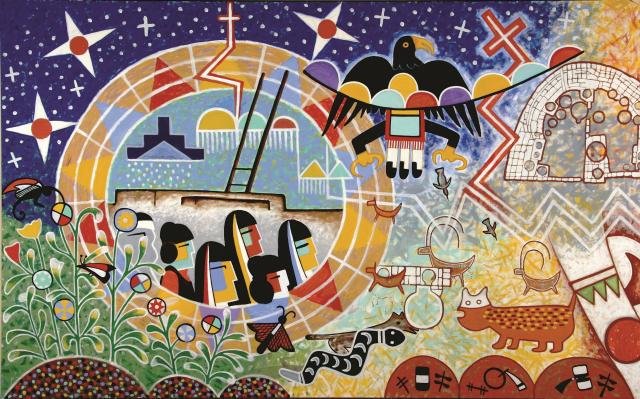
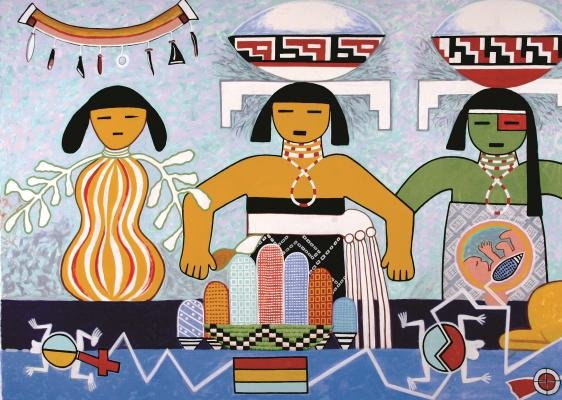
This vibrant, sweeping mural chronicles a concentrated history of the Hopi people, from their rich ancestral emergence to their tragic conquest by the Spanish to their transition into the modern age of industrialization and technology. The mural is decorated with evocative and ethnic symbols that represent both environmental harmony and destruction. Kabotie and Delbridge use bold colors and geometric shapes to unite human, animal, plant, and mechanical forms under a single canvas, conveying at once the dynamism of human agency and the living soul of organic matter on earth. Despite the mural’s beauty, the artists are unafraid to expose viewers to the dark consequences of colonialism: in the second panel, an embittered tribe member stabs a missionary in front of a Catholic Church that was built on Hopi sacred ground, recalling the events of the Pueblo Revolt in 1680; in the fifth panel, a coal-slurry pipeline contaminates the turquoise waters of an underground aquifer. These are just a few of the many intimations of irreversible environmental and cultural annihilation that are inflicted in the name of “progress” and “development” by institutions. Label by Tara Vasanth