Strangers by Environmental Humanities Hub

Edel Rodriguez, American, born 1971

Strangers, 2018

Artist Edel Rodriguez was born in Havana in 1971. He is formally a writer/illustrator, who tackles issues of systemic oppression by governments and current day issues affecting those disenfranchised by society. Rodriguez is discussing the mass migration movement of people from the global south to the north in 2018, the title Strangers hints at how immigrants are considered to be less than human (depicted by ghosts and monsters) or what Eden refers to as “boat people” who are dangerous and not welcomed within the country they seek asylum within. In his own description he points to acceptance of immigration to the U.S despite potential dangers, he gives the example of Irish gangs or Italian mafias, but now the U.S seems to be scared to grant asylum because they are frightened of potential threats. Label by Isabel Schreur

Once a refugee fleeing from Cuba, Edel Rodriguez painted what others call “Boat People.” This boat full of strangers is filled with faces, some ominous, others ghostly. Their expressions reveal little about their motives, aspirations, or feelings. The only indication of their collective intentions is a white flag of surrender and peace on the tail of the boat. The monochromatic blues inform only a sense of expansion from sky to ocean and beyond. Even so, the boat sails toward darker skies, a warning of storms ahead. In reference to this piece, Rodriguez explained that the United States used to be a country that assumed the danger of immigration without hesitation. He then asserted, “This country now seems scared to take risks on foreigners, to bet on the possibility that the next boat full of strangers might be full of greatness.” Label by Katie Lee
When Ice Stretched On for Miles by Environmental Humanities Hub

Gail Tremblay, Mi'kmaq and Onondaga, born 1945

When Ice Stretched On for Miles, 2017

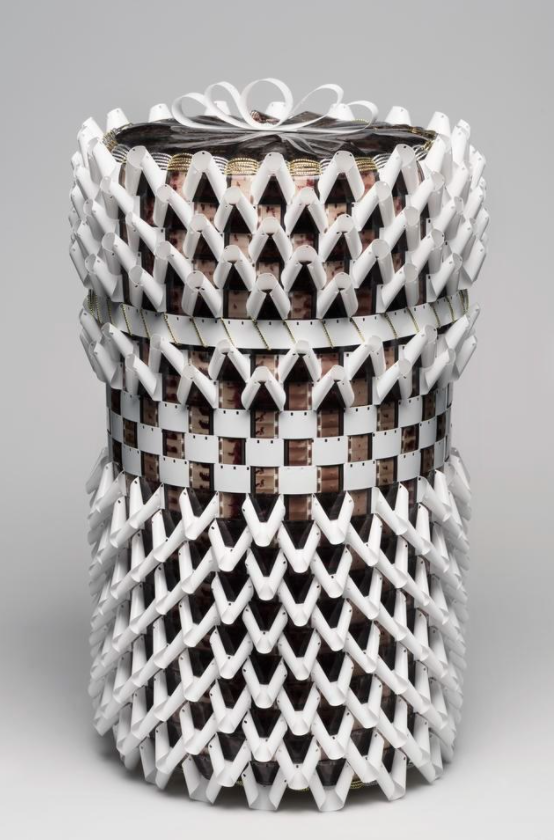
Artist and poet, Gail Tremblay created this handwoven basket, featuring a traditional style of weaving while using unorthodox materials, titled When Ice Stretched on for Miles. Woven throughout the basket is 16-millimeter film footage that depicts a documentary about the indigenous way of life in the Canadian Arctic. The irony in this documentary is that due to environmental harm by humans, many changes have occurred to indigenous life. The material choices the artist made when creating the basket were clearly intentional, as Gail is merging native past with the challenges of the present day—demonstrated by the traditional weaving style, but the use of modern materials and aesthetics. Gail recently stated in an interview, “Plants are dying, animals are dying, all kinds of things are out of balance … I try to address these issues in my work because people do need to think about them.” Art is an important form of communication for Gail, and it is a clear way to spread awareness of her culture’s changing lifestyle due to destruction of the environment. Label by Maeve Marsh

Survival of the Richest by Environmental Humanities Hub

Matt Huynh, US-based Vietnamese-Australian

Survival of the Richest

This is an illustration by multi-award-winning artist and storyteller Matt Huynh, for a podcast “Survival of the Richest” by Douglas Rushkoff (Future Human, July 5, 2018). The podcast told a real story and analyzed how the elite who have the power and financial resources to combat the disastrous impact of climate change would leave the poor behind. The current environment of the venture capital world has shaped the elite’s passive belief in a way that the future is no longer a result of our present-day decision but rather a predestined scenario. Both the podcast and this art piece point out the mindset of individual survival of the elite class, and their ignorance of the issues faced by the poor. Label by Yifei He

Refugee Astronaut by Environmental Humanities Hub

Yinka Shonibare, British-Nigerian, born 1962


Refugee Astronaut, 2015

Yinka Shonibare was born in London of Yoruba heritage and grew up in both Nigeria and Britain. The astronaut, along with the range of textiles and materials, is a recurring theme in Shonibare's work. His Refugee Astronaut brings to mind thoughts of humanity’s future while also raising critical questions about present-day issues. Where is the astronaut coming from, where is he going, and why does he seek refuge? On close inspection, the possessions the figure has packed, including a toothbrush, survey equipment, and kitchenware, as well as the materials he adorns, demonstrates globalization, climate change, and our current refugee crisis. Label by Isabel Williams

Yinka Shonibare’s Refugee Astronaut is a prime example of the British-Nigerian artist’s characteristic exploration of identity, post-colonialism, and globalization. Utilizing his trademark Ankara fabric and faceless globe, Shonibare created an astronaut refugee leaning forward into the unknown with the heavy weight of the bit and pieces of his life, which are simultaneously a large burden and not nearly enough to support him wherever he is going. The viewer of the piece may ask “is his helmet protecting him from polluted air and his suit from his toxic surroundings?”, “Will he find somewhere that is still habitable?” Or “Will the clocks on his suit run out of time?” This piece not only acknowledges the position that climate refugees are placed in, but also elements of justice; although space exploration has held the connotation of a white endeavor, Shonibare’s astronauts typically are dressed using fabric similar to traditional Nigerian textiles. Label by Molly McCarthy Flood